Soul Purpose 360o
National Survey of Black Women & Girls in Britain
Understanding Our Experiences, Challenges, Aspirations and Priorities for Social Change
Welcome to #DefinitionRedefined
Your voice matters. Your experience matters. Your contribution can help create change.
Thank you for taking part in the most comprehensive survey of Black Women and Girls in the UK, ensuring that women and girls can voice their priorities and propose the changes required for them to thrive.
#DefinitionRedefined was launched in 2024 to challenge limiting narratives and create space for Black Women and Girls to define ourselves in the fullness of our lives. A national conference, a photographic exhibition and a Black Woman's Anthology 'Owning Every Line', have laid the foundation for the campaign. This national survey is an important next step: an opportunity to build a stronger, community-led picture of our experiences, contributions, needs, priorities and aspirations across the UK.
The survey is for women aged 16 and over who identify as Black women or girls and live in England, Scotland, Wales or Northern Ireland. This includes people of Black African, Black Caribbean, mixed Black heritage and other self-described Black identities. There is no single Black woman’s experience, and we want the findings to reflect the breadth and diversity of our communities.
Biggest National Survey of Black Women & Girls.
Too many decisions about our health, homes, work and safety are still made with data that leaves us out or lumps us in. It's time we wrote the definition.
Because it is one of the largest surveys of its kind, it is a long survey. The survey is expected to take around 40 minutes. To help you, we have created a Conversation Gathering Toolkit available via our website to turn this into a fun and engaging activity that you can do to bring other women and girls together to stimulate conversation and debate. There are seven comfort breaks built into the survey. You can save your progress and return to the survey later. To resume, please use the same device you used to start the form. Please approach the questions in the way that feels right for you. After section C, you may skip questions, leave out sections that do not apply to you, pause or exit at any time, and answer only what you feel comfortable sharing. There are no right or wrong answers: we want to hear what is true for you, including experiences of challenge, joy, leadership, care, ambition, achievement and change.
Your contributions will be treated as confidential. We will use appropriate safeguards to protect the information you share and will report findings in ways designed to prevent individual respondents from being identified. The survey does not collect names or email addresses. If you choose to provide them, you will be guided to an external link to complete another short form. This information will be kept safe and used only for the purposes explained to you. Contact details will not be linked to your survey answers.
Some questions cover difficult or sensitive experiences. Clear safeguarding information and links to sources of support are provided on our website via survey links. Please take care of yourself, pause if you need to, and do not include names, addresses or other details that could identify you or someone else in open-text answers.
This survey is not monitored in real time and is not an emergency or crisis-reporting service. If you or someone else is in immediate danger, please contact the emergency services or use the support information provided.
Your contribution will help inform:
The #DefinitionRedefined campaign; and
The proposed National Commission on Black Women and Girls.
Future Soul Purpose 360 services
Empowerment Circle programmes
Research and evidence gathering
Funding and investment priorities
Advocacy and policy recommendations.
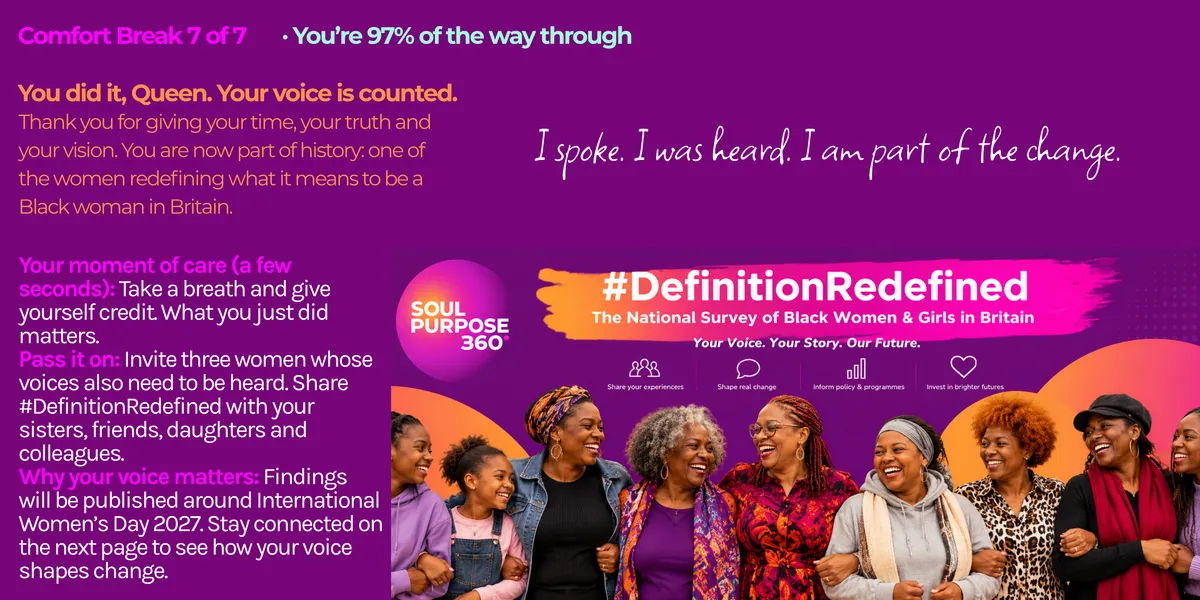
We hope to publish the survey findings for International Women’s Day in March 2027. Participants who choose to provide contact details will receive a public summary, accessible findings and a “You Said, We Will” update showing how the voices shared through this survey have shaped priorities and next steps.
Thank you for giving your time, insight and truth to this work. By taking part, you are helping to build evidence that can strengthen services, direct investment, influence policy and support a future in which Black women and girls are heard, valued, represented and able to thrive.
Be heard. Be counted. Help redefine the future.
#DefinitionRedefined | Soul Purpose 360
Thank you in advance,
Palma Black
Founder & CEO
Soul Purpose 360 CIC
Company No: 12217224 | Reg Add: Soul-Full, 62 George Street, Croydon, London, CR0 1PD
SECTION A: CONSENT, SAFEGUARDING & DATA PROTECTION
Black women's stories have too often been taken without care or credit, so this section makes sure you stay in control of your voice, your data and your wellbeing from the very first question.
If No, please do not continue.
Data Protection Consent (UK GDPR)
Please indicate your agreement:
SECTION B: ABOUT YOU
Black women are too often treated as one group, which hides the real differences in our lives, so these questions let us show the true diversity of who we are and where the gaps really lie.
SECTION C: YOUR BIGGEST CONCERNS
Decisions about Black women's lives are usually made without asking us what matters most, so your top three priorities will set the agenda for this campaign and the change we fight for.
Select just ONE from each of the three following - DO NOT pick the same issue three times.
SECTION D: #DEFINITIONREDEFINED - YOUR DEFINITIONS... REDEFINED
Black women have long been defined by others' assumptions rather than our own truth, so these questions put the power back in your hands to define success, wealth and living well on your terms.
Key statistic: 98% of Black Britons say they have compromised how they express themselves and their identity to fit in at work. (Black British Voices Report, University of Cambridge, 2023)
To what extent do you agree with these statements about owning your narrative and being recognised in your full diversity?
SECTION E: PHYSICAL HEALTH & HEALTHCARE
Black women in the UK are more likely to have their pain dismissed and to face worse health outcomes, including in maternity care, so your answers will help show the NHS exactly where it must listen and change.
Key statistic: Black women in the UK are more than twice as likely as white women to die during or after pregnancy. (MBRRACE-UK, 2025 report, covering 2021–23)
Please rate these statements
SECTION F: MENTAL HEALTH & EMOTIONAL WELLBEING
Black women carry heavy loads of stress, racism and caring, often while being expected to “stay strong”, so these questions help show the real toll and what culturally safe support should look like.
Key statistic: 29% of Black women have a common mental health condition, compared with 21% of White British women. (Adult Psychiatric Morbidity Survey, 2014 – the latest breakdown by both ethnicity and gender on the Government’s Ethnicity Facts and Figures site).
SECTION G: HOUSING & HOMELESSNESS
Black women are more likely to live in insecure, overcrowded or unaffordable homes and to face poor treatment from landlords, so your experiences will help push for safe, secure and fair housing for all.
Key statistic: Black people in England are three and a half times as likely as White British people to experience statutory homelessness. (Heriot-Watt University & ROTA, 2022)
Please rate these statements
SECTION H: EDUCATION, LEARNING & SKILLS
Many Black women and girls have faced low expectations, unfair discipline and a lack of recognition in education, so these questions help show how learning can nurture rather than limit our potential.
Key statistic: In 2021–22, Black Caribbean girls were excluded from school at double the rate of White British girls. (Department for Education data obtained by Agenda Alliance, reported by the Race Equality Foundation, 2024)
Please rate these statements
SECTION I: EMPLOYMENT, CAREERS & ENTREPRENEURSHIP
Black women face a combined pay gap based on both race and gender, are held back from progressing, and receive only a tiny share of business investment, so your answers will build the evidence needed for fair pay, promotion and funding.
Key statistic: 75% of women of colour have experienced racism at work. (Broken Ladders, Fawcett Society & Runnymede Trust, 2022)
Please rate these statements
SECTION J: MONEY & FINANCIAL SECURITY
Black women are more likely to be on low incomes, to have fewer savings to fall back on, and to be shut out of fair credit, so these questions help show the true impact of the cost-of-living crisis and what real financial security would take.
Key statistic: The typical Black African household in Great Britain holds £34,000 in wealth, compared with £314,000 for White British households. (ONS, Household Wealth by Ethnicity, 2016–18)
How confident are you about:
Rate these statements:
SECTION K: CARERS & CARING RESPONSIBILITIES
There are no right or wrong answers, and you can skip any question.
Black women often carry unpaid caring roles for children, elders and the wider community, at great personal and financial cost, so these questions help make that hidden work visible and properly valued.
Key statistic: 38% of Black, Asian and minority ethnic carers were struggling to make ends meet, compared with 27% of white carers. (Carers UK, 2020 data, published 2022)
SECTION L: COMMUNITY SAFETY
Black women are often left feeling both unsafe and unprotected, in our neighbourhoods, on transport and by the services meant to keep us safe, so your answers will help shape safer communities that truly include us.
Key statistic: 87% of Black Britons have little or no trust in Britain's criminal justice system. (Black British Voices Report, University of Cambridge, 2023)
Rate these statements
SECTION M: DOMESTIC ABUSE & VIOLENCE AGAINST WOMEN AND GIRLS
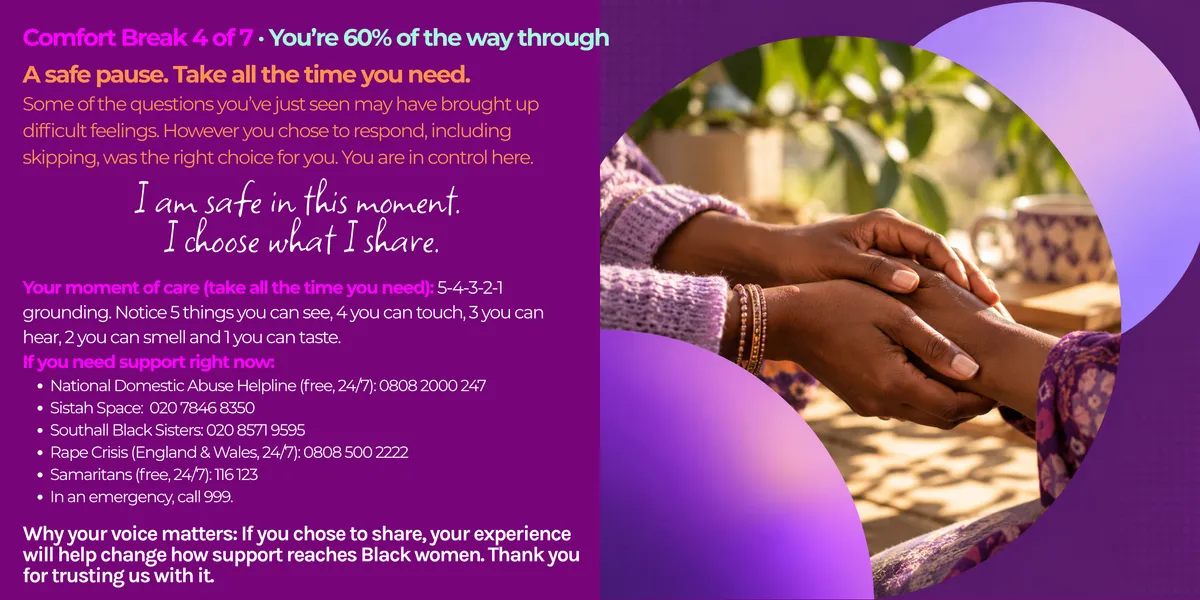
Section M asks four brief questions about experiences of domestic abuse and violence against women and girls. You can answer this section, or skip to Section N. Support agencies can be found here: Support Agencies (PDF)
Black women experiencing abuse often face extra barriers to help, such as not being believed, fear of services and a lack of culturally specific support, so these questions (all optional) will help break down those barriers.
Key statistic: NHS commissioning bodies (Integrated Care Boards) in England gave at least £2.79 million to 18 mainstream services tackling violence against women and girls. Only £47,000 went to a single specialist service run by and for Black and minoritised women. (Imkaan, Out of Sight, Out of Mind, 2026)
SECTION N: IDENTITY, REPRESENTATION & BELONGING
Black women are often stereotyped, underrepresented or misrepresented in the media and public life, so these questions explore how that shapes our sense of belonging and what real recognition looks like.
Key statistic: Over 93% of Black Britons say Black men and women are negatively stereotyped by the media, film and television. (Black British Voices Report, University of Cambridge, 2023)
Rate the following statements
SECTION O: CIVIC ENGAGEMENT & LEADERSHIP
Black women lead and hold communities together every day, yet we remain underrepresented where decisions are made, so these questions show what would help more of us step into power and influence.
Key statistic: Of the 650 MPs elected in 2024, only 50 are ethnic minority women. (Centenary Action, 2024)
SECTION P: DIGITAL INCLUSION
Unequal access to devices, skills and safe online spaces, plus high levels of online abuse, can shut Black women out of opportunities, so your answers will help shape a fairer and safer digital world.
Key statistic: Black women were 84% more likely than white women to be mentioned in abusive or problematic tweets. (Amnesty International, UK & US study, 2017 data)
Rate your confidence in using the following
SECTION Q: FAITH, SPIRITUALITY & PURPOSE
Faith and spirituality are a vital source of strength and community for many Black women, yet they are rarely recognised by services, so these questions help show the role they play in our wellbeing.
Key statistic: 84% of Black Britons describe themselves as religious or spiritual. (Black British Voices Report, University of Cambridge, 2023)
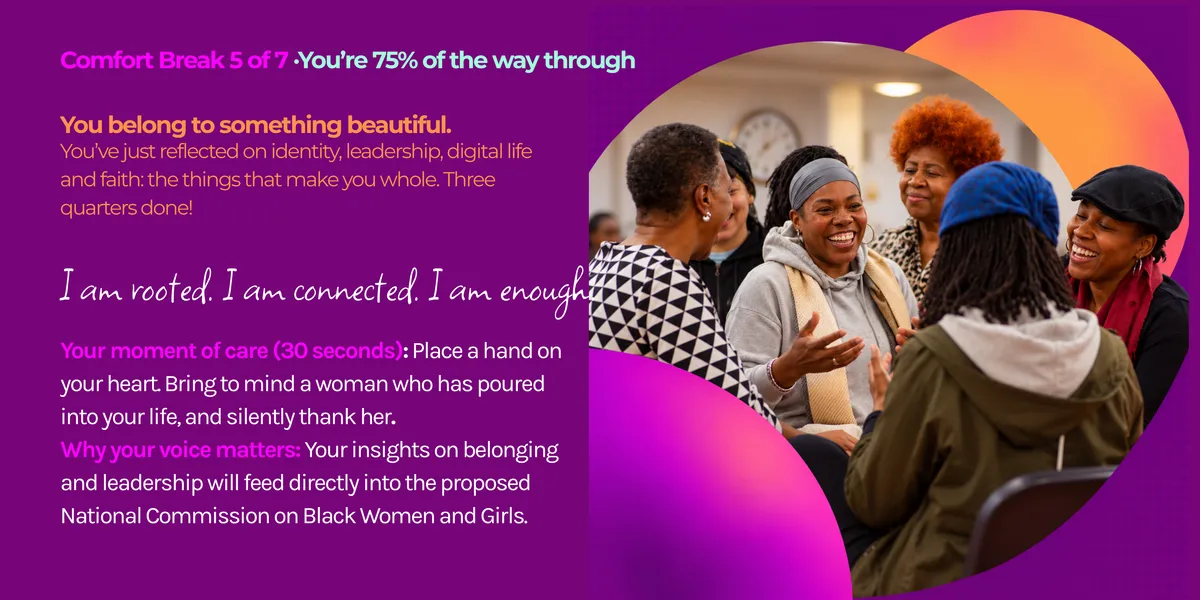
Rate the following
SECTION R: CLIMATE, ENVIRONMENT & PLACE
According to available data, Black women are more likely to live in areas with poorer air, fewer green spaces and the threat of being priced out, so your voice will help ensure we shape our neighbourhoods rather than being pushed out of them.
Key statistic: Black Londoners are more likely to live in the capital's most polluted areas. (Greater London Authority, Air Quality Exposure and Inequalities Study, 2023)
To what extent do you agree with these statements about the area where you live?
SECTION S: AGEING WELL
Black women often reach later life with less financial security, while menopause symptoms go overlooked at home, at work and in healthcare, so these questions help plan for an older age that is healthy, secure and dignified.
Key statistic: 88% of Black women surveyed received no menopause education at school, and 58% felt completely uninformed about it before the age of 40. (UCL survey of 377 Black women, 2026)
How confident are you about:
If appropriate, has perimenopause/menopause affected:
SECTION T: DISABILITY, NEURODIVERSITY & ACCESSIBILITY
Disabled and neurodivergent Black women are often missed, misdiagnosed or unsupported because of the combined effects of race, gender and disability, so your experiences will help make services truly accessible.
SECTION U: JOY, STRENGTHS & ASPIRATIONS
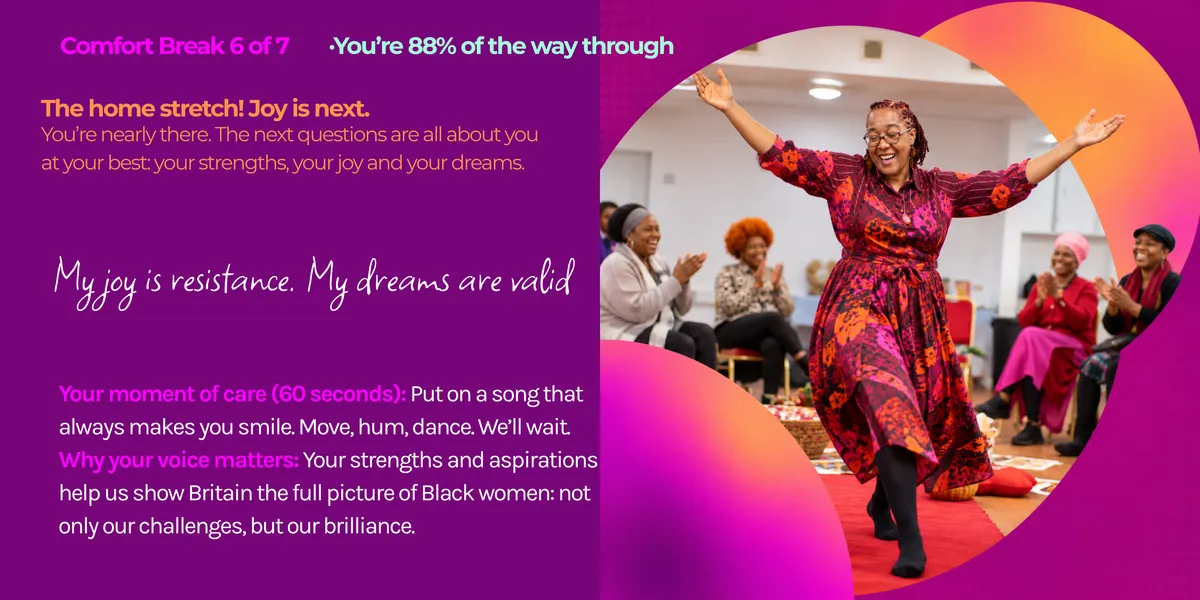
Black women are too often discussed only through our struggles, so this section celebrates our strengths, joy and dreams as the foundation for the future we are building.
Tick all that apply
Rate the following statements
SECTION V: THE FUTURE OF SOUL PURPOSE 360 & THE MOVEMENT FOR CHANGE
Lasting change happens when Black women organise and lead together, so these questions invite you to shape the movement, our vision for 2035 and the message we take to decision-makers.
To join our FREE membership, visit Membership to learn more and complete an application form.
STAYING IN TOUCH
If you would like to receive updates about this survey, or even participate in an online focus group after the survey closes, please click this LINK to share your contact details. Your answers are confidential: we will never publish your name or any detail that could identify you, and we only report results for groups of 10 or more women.